
AI has allowed commercial kitchen operators to streamline operations, reduce downtime, and increase operational efficiency.
It’s accelerating through our industry at an unprecedented rate, and one person who’s witnessed this rapid acceleration and development first-hand is Matthew Heavens, dealer sales manager at Unox.
We sat down with Matt to discuss some of the key benefits of the use of AI in the foodservice equipment industry.

Key takeaways from this article
- AI-powered technology will help overcome training challenges and improve consistency.
- More businesses are introducing formal AI policies.
- Added value for end users matters more than shiny new technology.
- AI is monitoring certain trends and directly influencing purchasing decisions in our industry.
- Full automation isn’t happening any time soon. AI will assist operators rather than totally replace the front-of-house experience.
When did you first become aware of AI’s impact on the foodservice experience?
I first became aware of AI’s potential in our industry several years ago when it began to look at trends and give feedback on expected stock levels.
I then started noticing it become more mainstream with the smaller developers, and it’s now much more popular across the entire foodservice equipment industry.
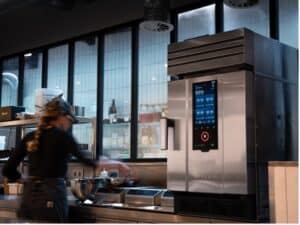
But we can’t fall into the trap of thinking that, because a piece of technology includes AI, it must be great. As manufacturers, we have to look at what to invest in and what offers the best service. It’s on us to assess the limits of AI first and really think about what we’re doing with the data we’re given.
When we came out with the X-Generation range, it had to add value to our customers, not just be a nice-looking piece of equipment. We needed to be clear on the benefits it provided and how it would enhance their operations moving forward.
Yes, we can use AI behind the scenes to analyse results and find the best solutions, but that research isn’t necessarily going to help with the user experience straight away.
When you start to integrate it, as we have via the Digital.ID™ control panel (more information on this below), that’s where the user benefits most.
You have to choose the right time to implement AI into your equipment, rather than implementing AI technology for the sake of it. Only once you trust the technology is it the right time to bring it to market.
Are companies having to create policies around AI and how they use it?
Yes, we’re all having to create an AI policy that stipulates what we can and can’t do with AI. This wasn’t a thing a few years ago, but more and more businesses are having to create this policy as AI continues to become more powerful.

I could also see there being AI-related clauses in insurance contracts in the future. As the usage increases, so too does the number of risks, particularly around data protection and potential scams.
How do you feel AI has shaped your industry over the last few years?
End users are much more clued up on data and systems thanks to AI. This is heavily front-of-house driven and is subsequently being reflected in the decisions being made back-of-house.
A lot of the equipment can now report back to a cloud which the end user can pull data from. Using this data, they can work out which trends are taking place in their kitchen.

Even the use of AI in marketing is shaping people’s perceptions and creating certain trends in our industry. The algorithms push a certain brand or concept and suddenly it’s everywhere, and that creates a demand that filters through to commercial kitchens. Recently, it’s been jacket potatoes. Tomorrow, it could be burgers or cheese toasties. You never know where the next big trend is coming from, as AI has created a whole new world of possibilities.
As demand grows, kitchen operators think, ‘This is a great idea, but we don’t want to invest loads into labour as we did previously. What technology is available to help us meet this demand?’
AI is probably having more of an impact on the front-of-house concepts that are driving the equipment than the equipment itself.
What opportunities do you think AI has created for companies in the foodservice equipment industry?
It’s allowed people to streamline operations across the board.
When you’re writing an email to a supplier, AI can help you sharpen the email and make it more to-the-point.
It’s also great at taking emotion out of things, which can be very important for people in our industry. For example, when distributors are communicating with frustrated end users, AI can prove invaluable in maintaining professional communication. Sometimes, we become so engrossed in something that we lose sight of what we’re trying to achieve, and AI is very good at removing the passion and presenting the facts.

From a manufacturer’s perspective, AI allows you to drum up interest in your product without having to wait for a marketing agency to create content around it.
If you’re trying to jump on the back of an industry trend that may be short-lived, AI is a life-saver. You can use it to quickly create a series of animations, images, or presentation decks that enable people to understand your product and what you’re trying to achieve.
What potential threats could AI create? What are some of the unknowns around it?
AI has the potential to remove labour or change labour habits.
It won’t replace everybody, but it’ll assist a lot of people, and some positions will be made redundant as people’s roles shift and evolve.
I think it will have a big influence back-of-house in terms of stock management — in a positive or negative sense, we don’t yet know.
Despite the advances in AI, end users still need that human touch.

I’m not a fan of having QR codes on tables, as this just encourages people to be glued to their phones and reduces face-to-face interactions. I feel that, in the foodservice industry, we’re so tied to technology that we run the risk of losing human connection, which makes our industry so unique.
How do you think the older generations are adapting to this technology?
The older operators are still adapting to it. Many of them are still doing things the way they’ve always been taught, as that’s their comfort zone.
What is pushing the older generation to embrace AI is the pressure they’re being put under to cut costs and reduce unnecessary admin. They’re starting to realise that AI can help them get time back.
Instead of their staff spending an average of two hours per week in the office, suddenly they’re spending half an hour in the office because AI is taking the fridge temperatures, doing the deliveries, and calculating what to order. All of these jobs are saving operators time which they can put back into the business.
What experience and expertise does Unox have in the AI space?
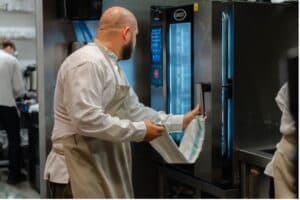
Our X-Generation range — specifically, the CHEFTOP-X™ and BAKERTOP-X™ commercial combi ovens — has AI built into the control panel. The control panel itself is called Digital.ID™.
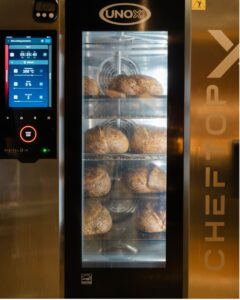
The AI experience here is twofold.
Firstly, users can customise that interface as much as they wish. They are prompted to give feedback as they would if they were using a phone, and they can do so. If they’re roasting a joint of meat, they’re asked at the end of the process whether or not it was to their liking, and their feedback helps them get the results that are actually required.
Secondly, users can see what’s being loaded into their oven via OPTIC.Cooking, an advanced AI system featuring built-in cameras and distance sensors that sit above the unit. You train the system, and then it looks at what’s being loaded and automatically launches the correct cooking programme based on the items it’s recognised.
That’s all done through AI, as is the self-learning when you’re programming the technology. These elements work seamlessly together to maximise efficiency in commercial kitchen operations.
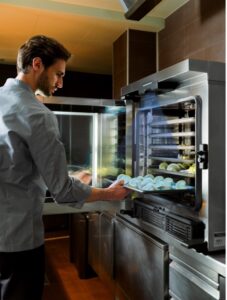
How has OPTIC.Cooking been received in the commercial catering industry world?
Really well, and it’s ideal for the markets where menu changes are little and often.
In the QSR (Quick Service Restaurant) sector, where the menu doesn’t change much, there is some scepticism around it. But the overarching objective of this technology is to make everything easy.
OPTIC.Cooking removes the element of risk arising from someone being untrained or relatively unskilled or the uncertainty over a specific product. It recognises the food and launches it straight away, and it’s ideal for the markets that require it.
What AI capabilities does the CHEFTOP-X™ combi-oven have?
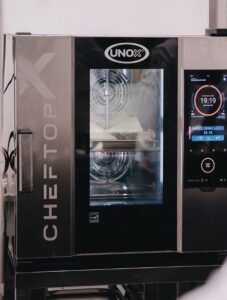
CHEFTOP-X™ can air fry over six to ten trays of food and ask for feedback thanks to its built-in AI technology. It’s individually based on what the end user wants and they can transfer the data when they go from one site to another. They simply log in on their phone and everything is transferred.
We’re moving away from the manual setting and towards a preset programme. By giving CHEFTOP-X™ feedback, the end user is getting an individualised, tailored experience that delivers their unique business result over and over again.
What else is Unox working on in the AI space?
We’ve got a big research and development team that’s working on the future developments of our range.
The key focus is on our existing X-Generation and SPEED-X™. I think the next phases will focus on reporting or assistance for engineers and the end user.
Our aim is to reach a point where the technology is making suggestions based on what’s happening in the oven, rather than just taking prompts from the end user.
How do you see AI impacting the foodservice equipment industry in the next five to ten years?
I think engineers will use tablets or laptops to help diagnose an issue or submit a request to the equipment manufacturer.
As for end users, AI will prove invaluable in training them how to use certain pieces of equipment and providing them with the best experience.
It’ll also help with how the food is controlled, how orders are managed, and how customers interact with the equipment, whether that’s on a touchscreen or something else.
There won’t be a radical change straight away, but over time, these are some of the developments I can see taking place.
How can foodservice equipment dealers harness AI’s potential?
I think they’re already doing this when it comes to time management, but they’re also starting to understand equipment capabilities. They’re figuring out how to sell or design this equipment for the kitchen of the future.
Traditional designs are still being produced, but designs will have to evolve due to space requirements and potential robots that might be in the kitchen.
It could be that AI is used to provide simulations of how a piece of equipment would operate in a commercial kitchen, which would massively help distributors to grasp its capabilities. Some people can’t read a 2D design, but AI will make that 2D design easier to understand and more applicable to a real-life scenario.
What’s next for AI in commercial catering?
We’re going to see much more automation around ordering. It could be as simple as ordering the cleaners required for your oven, for example.
AI could also help decide where restaurants are located. It can spot trends, see where different types of customers live, and predict, for example, whether or not a certain concept will work best with a younger market in a student-heavy area. It can highlight busy and quiet times and recommend what resources you need. All of that is driven by a model working in the background.
As for equipment, I think we’ll see more focus and engagement around training. Training is a challenge everywhere, and AI will help make it more operational and accessible.
We’ll still need human operators – I don’t think we’re heading for fully robotic kitchens just yet. It’s more likely AI will manage everything in the space, whether that be through flagging service issues or handling stock needs. It won’t reinvent the wheel, as the foundations are already there. It’ll just take these foundations to the next level.
To summarise, how can the reader adapt to the new age?
AI isn’t going anywhere, and we shouldn’t be afraid of it. We need to learn how to embrace it, and how it can actually support with the challenges that we’re all facing.
If you learn with the technology, that also helps your future developments, because that’s the end result the market will see.
ENSE thanks Matt for providing these fascinating insights.
About Unox
Since being established in 1990, Unox has grown to become the world’s leading professional ovens brand.
With a team of over 1,200 talented individuals, the company is present in over 42 countries and distributes its high-tech ovens to more than 110 nations.
Unox UK Ltd has been a member of ENSE, the UK’s premier catering equipment buying consortium, since January 2026.
Enquire about joining ENSE today
If you’re a commercial foodservice equipment supplier or distributor looking to get in front of the right people, have high-quality conversations, and win more business, ENSE can help you do this and more.

The platform we offer allows commercial catering equipment suppliers to gain more traction with distributors and grow their market share. It also empowers the distributors to gain more knowledge which they can use to generate more business.
The best time to join ENSE was yesterday; the next best time is today.
Find out more about us and how we can help you by contacting us at 07775 643557, 07500 778457, or [email protected].