
Commercial kitchen operators could be wasting hundreds of pounds in unnecessary energy costs every year by not following simple refrigeration best practices.
We reached out to one of the members within our buying group to find out how to avoid this and maximise energy-efficient commercial refrigeration.
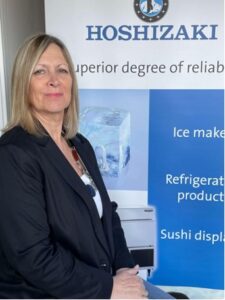
Roz Scourfield, National Sales Manager at Hoshizaki, sat down with us to provide her top tips.
How does the size, type, and placement of a commercial refrigeration unit maximise energy efficiency in commercial kitchens?
People often underestimate the space they need for putting a product in their commercial kitchen.
They focus on price, which is always the driver, to the detriment of having an energy-efficient product.
It’s essential to look for the right size of unit for your specific product storage needs, and for the space it’s going into.
Commercial refrigerators are often put into areas where there’s restricted airflow, which affects the efficiency of the product. That’s one of the key pointers that we communicate to our distributor base when we’re talking to them about selecting the right refrigerator.
If your refrigerator is jammed right up against the ceiling, you’re not going to get any airflow over the compressor, which could cause your running costs to increase and the breakdown of the cabinet in the long run.
If you operate in a hot environment with low ceilings, it may be worth considering bottom-mounted compressors. We have a range of units that include bottom-mounted compressors, which create a cooler environment at floor level.
Temperature range is important, too. Most refrigerators operate at +2°C to +12°C, but if you’re looking for something that can hold uncooked meat or fish products, for example, you should consider a product that’s going to hold at a lower temperature.
If you’re storing fresh meat, you should be storing that from around 0°C to +2°C. If you’re storing fish, the temperature should ideally be slightly lower; ideally 0°C to -5°C.
There is also a key difference between storage fridge or freezer and a service fridge or freezer.
Many ‘storage’ cabinets are put into areas where a service cabinet is required, i.e. one that is going to be utilised throughout the day with many door openings. By contrast, a storage cabinet is perhaps only opened a couple of times a day—for example, when taking out products for the main prep work.
What advantages does a hydrocarbon refrigerant like R290 present, and how has Hoshizaki integrated this into its units?
Most of our ice machines and refrigerators have operated using R290 for around 15 years.
It’s an energy-efficient refrigerant, and it’s ozone-friendly. It has zero ozone depletion potential (ODP), meaning it doesn’t harm the ozone layer.
It also has a far lower global warming potential (GWP) than other HFC (hydrofluorocarbon) refrigerants such as R134a and R404A.
The GWP for R290 is 3, compared to 1,490 and 3,922 for R134a and R404A respectively. This is why we’ve embraced R290 for a very long time and incorporated it into our products.
It’s worth noting that R290 is highly flammable, which presents certain challenges from a servicing standpoint. If you change a compressor, for example, you may have to take your unit off-site.
Do you ever encounter refrigerators that still use outdated refrigerants?
Some really old refrigerators still operate on refrigerants like R12.
This was very popular back in the day, but it was banned in the 1990s due to its ozone-depleting properties.
The insulation of these refrigerators is not energy-efficient or even environmentally-friendly.
The criteria have changed massively in recent years, and the industry is moving in the right direction. We’re now seeing more sustainable commercial refrigerators than ever before.
What do you recommend to keep refrigerators operating at peak efficiency?
The condenser coils should ideally be inspected and cleaned weekly to prevent dust, lint, dirt, or grease buildup, and you should generally keep the refrigerator tidy.
We recommend planned maintenance at least once a year. This should include standard servicing and a complete clean-through of the system.
With commercial refrigerators, the main thing to look out for is dust blocking the condenser.
The presence of oils and fats in the atmosphere can also cause condensers to become blocked, which means the compressor runs less efficiently. So, regular maintenance should involve cleaning these components if you’re not comfortable doing this yourself.
How you’re storing certain products is very important. You need to make sure you’re using the correct containers for specific items.
Where you’re storing products is essential as well. One of the biggest mistakes we see is when the bottom shelf is higher up and products are piled up at the base of the fridge, which completely blocks off the airflow.
When we attend a site, we’ll remove products from the bottom of the refrigerator to maintain regular airflow from the bottom.
Our refrigerators and freezers have a fan at the top which blows the air around the back and then up through the bottom for full circular airflow. This means there’s a uniform distribution of temperature throughout and your products are kept at a continual temperature range.
Having fan-assisted cooling helps to maintain a consistent temperature, especially if you’re opening and closing the refrigerator doors a lot. Some refrigerators don’t have this feature, so your air is going to ‘fall out’—the cold air will fall to the bottom, which affects the efficiency of your product.
How long should a commercial refrigerator be operational for in an ideal world?
Our warranty is three to six years on average, and your refrigerator should last between five and ten years if you follow best practices and ensure proper maintenance.
It all comes down to how well it’s looked after and how much you care for it.
How can commercial kitchens create a culture of energy efficiency across the board?
I think the big problem our industry has is that there are different types of expenditure that don’t align with each other. You’ve got capital expenditure for equipment, then you’ve got expenditure for food, energy, and so on. There isn’t a ‘common conversation’ which brings this together, unless it’s a new project involving multiple consultants.
We need to see more of this kind of communication across the board.
Unfortunately, I don’t think enough people are exercising that joined-up thinking.
In a lot of catering establishments, the front of house is seen as key, as that’s where the most money is spent. Decision-makers aren’t necessarily thinking about how they can save on their energy bills, as they see back-of-house as less important.
It may be that their business plan doesn’t look very far into the future, so they don’t want to pay for any ‘unnecessary’ increases in expenditure. That’s the problem, and people need to see energy efficiency as part of the bigger picture if we’re to create that sort of culture in our industry moving forward.
How do you see the future of commercial refrigeration?
I think it’s still going to be as challenging as it is now. The cost of energy will always be a big consideration, and, of course, food trends will change. For instance, we’re seeing a trend towards quick-service, or ‘grab and go’, restaurants since the COVID pandemic.
From a Hoshizaki perspective, we’ve got a good range of products that we’ve developed over the last two to three years.
These include our ice machines, which use less water than before, and our new variable-speed direct current (DC) pumps for making ice.
Using a DC powered drain pump as opposed to an alternating current pump will save end users energy as they get towards the end of making an ice cube because they won’t need so much energy to use it at the last cycle.
We’ll also be launching ice flakers with internal drain pumps in 2026.
We’re constantly making tweaks and changes to make commercial kitchens more energy-efficient environments and keep our clients one step ahead of the game.
To recap: what steps can a commercial kitchen operator take to reduce their refrigeration energy usage?
- Look for the right size of product for what you need to store and where you’re going to place it.
- Keep your refrigerator in an area which isn’t overheated and is going to get adequate airflow. If you don’t do this, then your refrigerator will struggle to run and use up more energy, causing your consumption to increase.
- Make sure that the product you’re putting into your refrigerator is stored correctly.
- Don’t overload your refrigerator.
- Don’t put it next to your cooking line, if you can help it.
- Look for refrigerators that have an A or B energy rating.
- Pay attention to your refrigerator’s climate class. Climate Class 5 is best—this means your refrigerator can operate in maximum ambient temperatures of 40°C with 40% RH (relative humidity). Some refrigerators will be Climate Class 3, meaning they operate at 25°C with 60% RH, which is not ideal for a commercial environment.
- Choosing units with long warranties is key if you’re looking to save on costs over a sustained period of time. If something breaks down and your unit only has a two-year warranty, you’re going to be charged quite a bit to get an engineer out and replace those parts.
How can the reader improve their energy efficiency by reaching out to Hoshizaki?
Hoshizaki is a leading manufacturer of professional refrigerated and ice solutions for food and beverage establishments. If you’d like to discuss your requirements, our qualified sales team is ready to talk you through the different options.
Our team has over 100 years of collective industry experience, and we’ve delivered energy-efficient products to market for around 20 years, so we know what does and doesn’t work.
Whatever back-of-house solutions you’re looking for, we’ve got something that will improve your energy efficiency. We can also provide expert training where required.
You can reach out to Roz today at [email protected] or 07879496892.
Enquire about joining ENSE today
We’re the UK’s premier catering equipment buying consortium and Hoshizaki is among our esteemed members.
If you’re a commercial foodservice equipment supplier or distributor looking to get in front of the right customers, ENSE can help you stand out, build stronger relationships, and win more business.
The platform we offer allows commercial catering equipment suppliers to gain more traction with distributors and grow their market share. It also empowers the distributors to gain more knowledge which they can use to generate more business.
The best time to join ENSE was yesterday; the next best time is today.
Find out more about us and how we can help you by contacting us at 07775 643557, 07500 778457, or [email protected].